How to Break the Binge Restrict Cycle
If you feel like you are either “being good” with food or completely out of control, you may be caught in the binge-restrict cycle. This pattern is common, but it is also predictable. And it makes sense once you understand what is happening in the body and brain.
Let’s break it down.
What Is the Binge-Restrict Cycle?
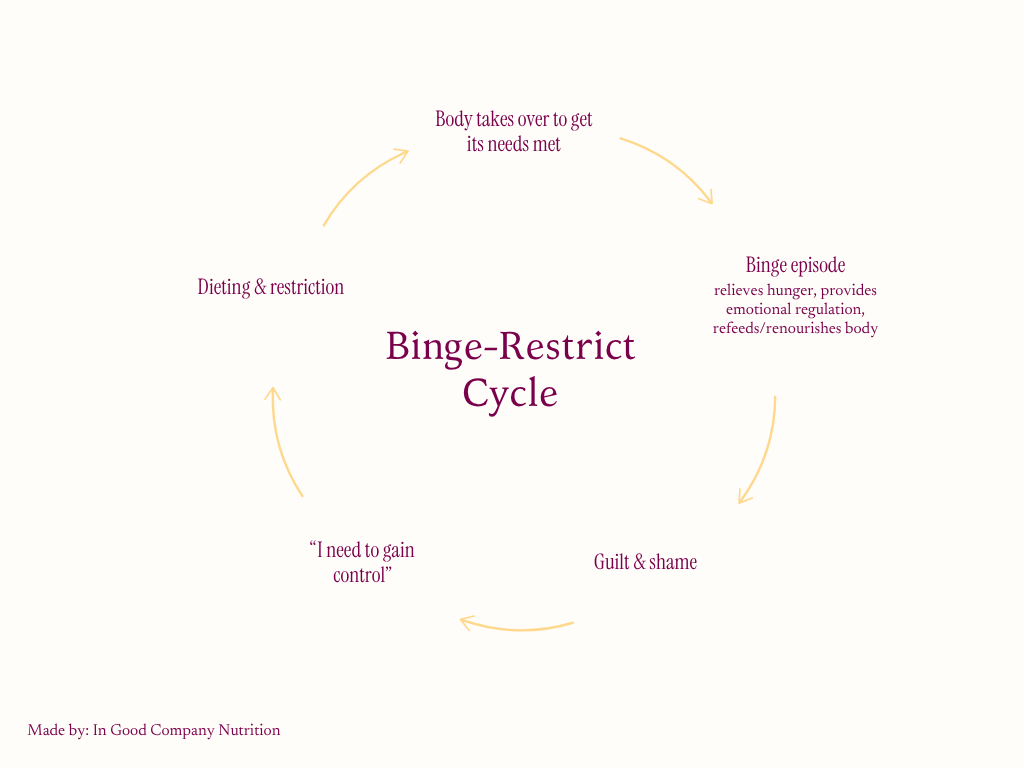
The binge-restrict cycle typically follows this pattern:
Restriction
Increased cravings and food preoccupation
Binge or loss-of-control eating
Guilt and shame
Renewed restriction
Then the cycle repeats. It is not a willpower issue or a personality flaw. The body does this as a response to deprivation.
What Counts as Restriction?
Restriction is not just skipping meals.
It can include:
Eating less than your body needs
Delaying meals despite hunger
Cutting out food groups
Only allowing “safe” foods
Trying to compensate for previous eating
Mentally labeling foods as good or bad
Ignoring cravings on purpose
Restriction can be physical, meaning not enough energy intake. But, it can also be psychological, meaning rigid rules or fear around food. The body responds to both.
What Happens When You Restrict
When your body senses restriction, it interprets it as a threat to survival.
In response:
Hunger hormones increase
Fullness cues can become less reliable
Food becomes more rewarding
Thoughts about food increase
Urgency around eating can increase
This is a biological response.
Research, including the Minnesota Starvation Experiment, shows that when people are deprived of adequate food, they become preoccupied with food and are more likely to eat past fullness when given access again. Your body is trying to protect you.
Why Binges Often Follow Restriction
After restriction, the body is primed to restore energy.
This can look like:
Eating quickly
Eating past fullness
Feeling disconnected while eating
Feeling unable to stop
The more restricted your system feels, the stronger the drive to eat. Bingeing is often the body’s attempt to correct an energy deficit, whether that deficit is physical, psychological, or both.
Why Trying Harder Does Not Solve It
After a binge, many people experience guilt or fear about weight changes. This often leads to renewed restriction in an attempt to regain control. Then, that restriction sets the stage for the next binge. That shame keeps the focus on the behavior, rather than the pattern. But, understanding the pattern helps interrupt it. If willpower alone could stop the cycle, it would have worked already.
The binge-restrict cycle is interrupted not by tighter control, but by reducing restriction.
That usually means:
Eating consistently throughout the day
Increasing overall intake if it has been inadequate
Practicing flexibility with previously restricted foods
Addressing fears around weight and control
This work can feel uncomfortable at first. Stability comes from consistency, not from strictness.
Steps Toward Breaking the Cycle
Here are starting points that often help:
1. Establish Regular Eating
Aim for meals and snacks every 3 to 4 hours. Regular intake reduces biological urgency later in the day.
2. Reduce Food Rules

The more forbidden a food feels, the more powerful it becomes. Gradual exposure and permission help reduce that intensity.
3. Increase Awareness Without Judgment
Instead of “I ruined it,” try asking:
What happened earlier in the day?
Was I physically or mentally restricting?
Curiosity is more effective than criticism.
4. Address the Fear Underneath Restriction
Restriction often serves a purpose. It may help manage anxiety, body image distress, or a desire for control. Working with those fears directly is essential.
A More Accurate Reframe
Bingeing is often a response to restriction. When we focus only on stopping bingeing without addressing restriction, the cycle continues.
When we stabilize nourishment and reduce scarcity, the intensity of binge urges typically decreases over time. Unfortunately, this is not immediate. It tends soften gradually over time. But it is reliable when the body feels safe and consistently fed.
If this sounds familiar, you are not alone in this pattern.
Many people who struggle with binge eating have a long history of dieting, food rules, or inconsistent nourishment.
The work of stepping out of the cycle involves:
Stabilizing intake
Reducing fear around food
Rebuilding trust with your body
Letting go of all-or-nothing thinking
If you are looking for support with this process, In Good Company Nutrition offers collaborative, weight-inclusive care rooted in science and nervous system awareness. You do not have to navigate this alone.